Swapping a Gas Range for Dual Fuel in a 1950s Lake Hills House
A dual-fuel Viking cooks on gas and bakes on electricity, so it needs two supplies where an all-gas range needed one and a plug. In a Lake Hills kitchen from the late 1950s, that second supply is the question to settle first. What to ask before the swap, and what shows up when nobody asked.
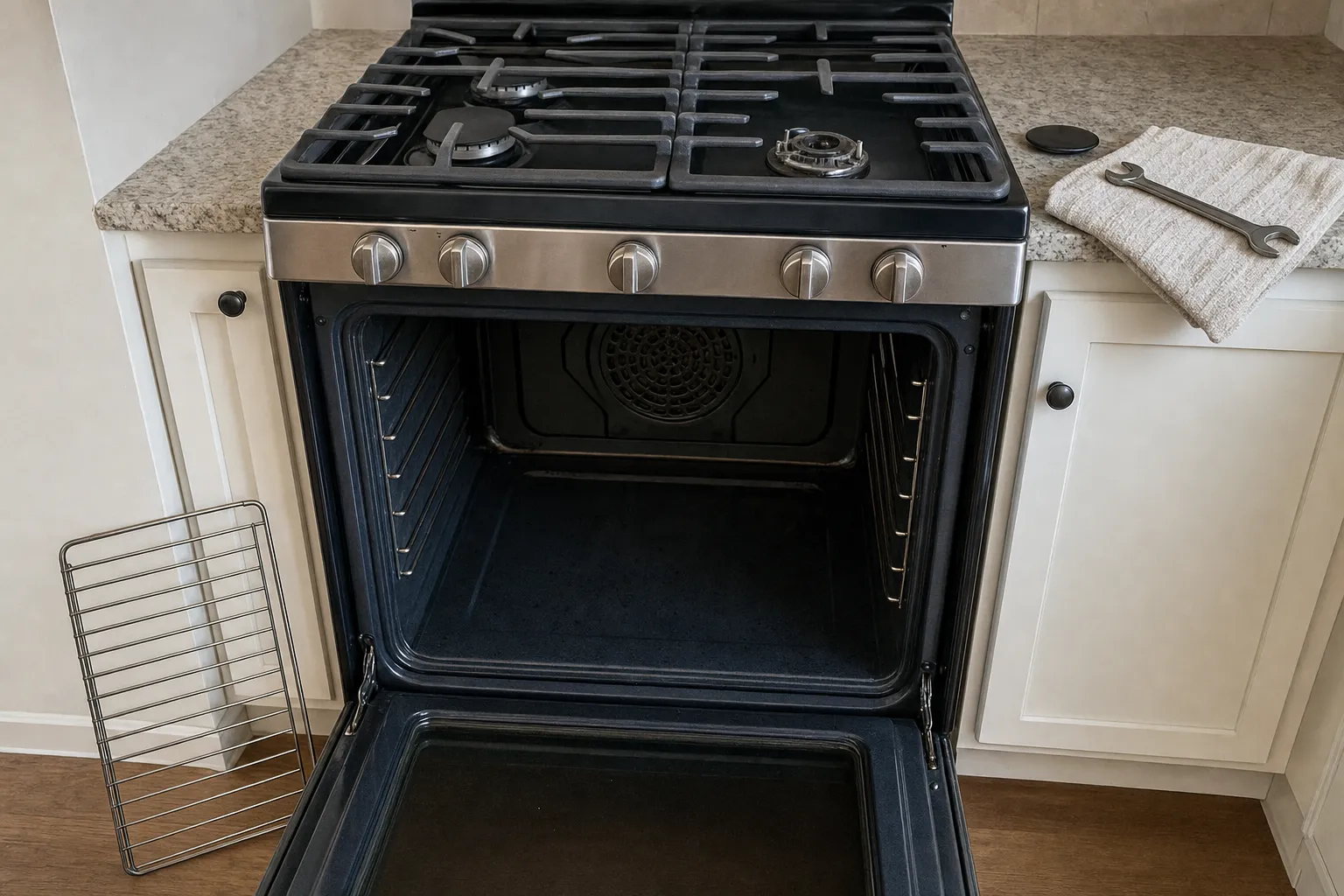
Lake Hills took shape at the end of the 1950s as a planned neighbourhood, and a lot of the Viking questions we hear from it turn on one change: an all-gas range going out and a dual-fuel range coming in. On the showroom floor the two look much alike. Behind the range they are not. The dual-fuel model needs something its predecessor never did, a 240-volt circuit for its electric oven, and whether the kitchen already has one is the question that decides how smoothly the swap goes.
Viking Repair Bellevue diagnoses and repairs the range. The circuit is an electrician’s work and the gas connection a gas fitter’s. What follows is what to settle with them before the new range arrives, and the faults a range tends to show when one of those steps was skipped.
What dual fuel asks of a kitchen
A dual-fuel Viking splits the work. The burners on top burn gas, exactly as before; the oven below heats with electric elements. So the range needs a gas supply for the cooktop and a full electrical supply for the oven, both at the same spot.
An all-gas Viking asks much less of the wiring. Its burners and oven both burn gas, and it plugs in so that its electric igniters can light them, which is why a power cut leaves the igniters dead while the gas is still there. The outlet behind an old gas range was put there for that job, and it is no substitute for an oven circuit.
As one example of what the electrical side involves, Viking’s installation manual for its 30-inch D3 dual-fuel range asks for a 240 or 208-volt supply, wired three-wire or four-wire, and fused separately from any other circuit. It adds that where local codes do not allow grounding through the neutral, a four-wire cord must be used. The rating differs from one model to the next, so the guide for the exact range you are buying is the one that counts. Read it before the electrician visits, or hand it over.
The 240-volt question in a Lake Hills kitchen
A kitchen from the late 1950s arrives at this swap in one of two states, and it is worth knowing which before anyone orders a range.
If the house has only ever cooked on gas, there may be no 240-volt supply anywhere near the range position. One has to be run from the panel, and whether the panel has room for another large circuit is part of the same conversation.
If an electric range stood there at some point, there may be an old range circuit still behind the wall. That is a start, not an answer. It was sized for whatever range it first served, it may be three-wire, which the D3 guide accepts only where local code allows grounding through the neutral, and it may not be on its own.
The questions to put to the electrician, then, are short:
- Is there a 240-volt supply at the range position today, and is it on a circuit of its own?
- Does its rating match what the installation guide for this range asks for?
- Is it three-wire or four-wire, and which does local code require for this installation?
- Can the panel take a new circuit if one is needed, and does the work need a permit?
On the D3, the electrical connection is made at a terminal block behind an access door on the back of the range, so the supply has to be ready and reachable before the range is pushed into place.
The gas side does not go away
A dual-fuel range still cooks on gas, so the gas connection behind it matters as much as ever. Capping, moving or reconnecting it is a gas fitter’s job and never an owner’s. Viking’s D3 manual calls for a shut-off valve in the line ahead of the range, placed where it can be reached quickly in an emergency, a heavy-duty flexible connector of an approved design, and a pressure check at the range once it is connected. None of that changes because the oven below has gone electric.
What we usually find after a swap that skipped a step
When a new dual-fuel range in a Bellevue kitchen misbehaves in its first weeks, what Viking Repair Bellevue often finds behind it is the house supply rather than the range. Three patterns account for most of it.
Most often, the breaker drops as the oven heats. A circuit smaller than the range needs, or one shared with another load, trips once the elements draw their full power. A shorted element can do the same thing, so the oven is tested as well, but when the range is only weeks old the supply is the likelier of the two.
Sometimes, the burners light and the oven stays cold. On an all-gas range that picture points into the oven’s own ignition. On dual fuel it can mean something else: sparking a burner draws very little, while the oven’s elements need the whole of the 240-volt supply. A connection that delivers one without the other leaves a cooktop that works perfectly over an oven that never warms.
Rarely, the range itself was set up wrong on arrival. A burner cap knocked off its seat in transit, a range left out of level, burner flames nobody looked at once the gas was connected. These are range faults, and they are the ones we fix.
When to call, and who
A breaker that trips as the oven heats: note the setting that was running, reset it once, and leave it off if it trips again. An oven that stays cold while the burners work: make sure a heating mode is selected and the range’s breaker is fully on, then call. Anything that smells of gas: everyone out, flip no switches, and ring Puget Sound Energy or 911 from well away from the house before anyone looks at the range.
For the range itself, have the model number ready, when it was installed, and anything the electrician or the installer told you about the circuit. That lets Viking Repair Bellevue, on (425) 696-2636, sort out quickly whether the answer lies in the range or behind it.
Follow-up questions
-
Can a dual-fuel Viking plug into the outlet the old gas range used?
No. That outlet was there so the old range could power its igniters. The electric oven in a dual-fuel range needs a 240-volt supply on a circuit of its own, as the range's installation guide spells out, and an electrician confirms or provides it before the range arrives. Once it is in and misbehaving, Viking Repair Bellevue tests the range on (425) 696-2636.
-
Is a breaker that trips on a brand-new range the range's fault?
Sometimes, but on a range only weeks old the supply deserves the first look: a breaker smaller than the guide asks for, or a circuit shared with something else. A shorted element is possible too. Write down the setting in use, try one reset, and if it goes again, keep the breaker off. Viking Repair Bellevue tests the oven side on (425) 696-2636.
-
Who should deal with the old gas connection during the swap?
A gas fitter. Capping, moving or reconnecting a gas supply is not owner work, and Viking's own gas range manual leaves installation to a qualified installer, service agency or the gas supplier. Any smell of gas: everyone out, then phone Puget Sound Energy or 911 once clear of the house. For the range itself afterwards, Viking Repair Bellevue is on (425) 696-2636.